
CCTLDs: Great Domains. Strange Rules. Expensive Lessons.
Residency rules, resale bans, and registries that take domains back. Jeff Gabriel breaks down the strangest ccTLD rules you should know before you buy. By Jeffrey Gabriel · Published October 29, 2026
Every few years, an article comes out listing the most ridiculous laws ever put into effect in the United States or around the world. Some are funny. Others leave you wondering how a chain of events led to such nonsense.
- In Alabama, it is illegal to run a bear-wrestling match.
- In California, a frog that dies in a frog-jumping contest cannot be eaten.
- In Washington State, harming Bigfoot is a crime.
- In Kentucky, anyone who dyes a duckling or rabbit and offers it for sale can be fined.
- In China, Tibetan living Buddhas need government permission to reincarnate.
- In the UK, handling salmon "in suspicious circumstances" is an offense.
I could go on. There are so many. So why am I writing about this?
What Are ccTLDs, and Why Do Their Rules Matter?
ccTLDs (country code top-level domains) are extensions assigned to specific countries or territories, and each one can set its own registration rules. Unlike gTLDs (generic top-level domains) such as .com, a ccTLD's registrant agreement can include residency requirements, resale bans, and content restrictions that the owner is expected to follow.
As a domain broker, I speak with people from all over the world. Some want to spend tens of thousands, hundreds of thousands, or even millions of dollars on a domain name. Sometimes those domains are on extensions like .ai, .co, .co.uk, .si, and .ca. What do they all have in common? They are ccTLDs.
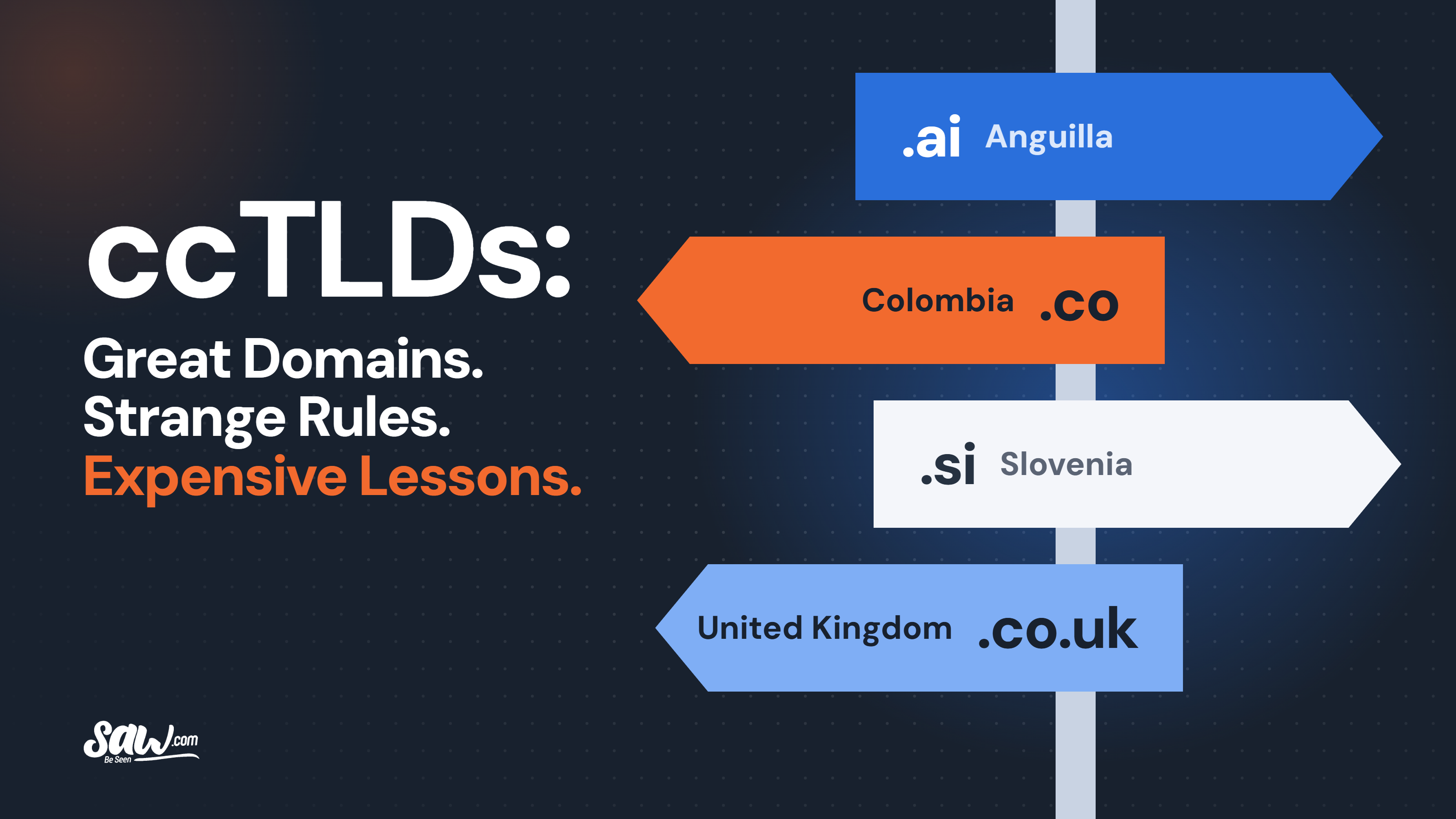
No, .ai does not mean Artificial Intelligence. .co does not mean company. And .si does not mean Super Intelligence, despite Donald Trump's efforts. These are country codes: .ai is Anguilla, .co is Colombia, .si is Slovenia, and .co.uk is the United Kingdom.
Some of these countries have pretty wild restrictions. I did some digging and found a few you might find as interesting as learning that in London, flying a kite to annoy people is an offense.
Which ccTLDs Require You to Live in the Country?
Residency is the most common restriction. To qualify, you usually need to live there, have part of your business there, or hold a local trademark. The exact rules vary by extension.
Extension | Country or Territory |
.us | United States |
.ca | Canada |
.au | Australia |
.co.jp | Japan |
.no | Norway |
.br | Brazil |
.fr | France |
.eu* | European Union |
.ie | Ireland |
.kr | South Korea |
.com.lb | Lebanon |
.lb | Lebanon |
.ru | Russia |
.aq | Antarctica |
.va | Vatican City |
Antarctica (.aq): Pack a Parka and Get a Note From Your Base Commander
The rule: Only government bodies or groups with a documented Antarctic presence qualify. Registration is free for 24 months, is usually limited to one name, and is handled by emailing Peter Mott in New Zealand.
Why it's surprising: A whole continent's extension is managed by email, and eligibility requires a letter from a base commander. I want one. Challenge accepted! Who's with me? Cold.aq? Miserable.aq?
Can a Registry Take Back a Domain You Bought?
Andorra (.ad): Buy It, Lose It
The rule: You cannot sell .ad domains.
How I know: A client had me purchase one for brand protection. When the domain landed in my account, the registry froze it and took it. Their reasoning was that since it had been listed for sale on Sedo, I must have bought it. I did, but for all the right reasons. I refunded my client, took it on the chin, and that was that.
What Are the Strictest ccTLD Content and Format Rules?
China (.cn): Real Name, Real ID, Real Photo, and Don't Hurt China's Feelings
The rule: Real-name verification is mandatory, with an ID or business license, and sometimes a photo of you holding your ID. Domain names may not oppose constitutional principles, endanger national security, harm "national honor," promote cults or superstition, or spread rumors. I believe this extends to the content on the website itself.
Why it's not surprising: It's China. What do you expect? I'm not a big fan of rules that come down to opinion or feelings. When I first got into the domain industry, anyone could register a .cn domain. Then the restrictions arrived, and many people had to forfeit their names.
Brazil (.br): 26 Characters Max
The rule: A .br domain can be no longer than 26 characters, while other TLDs accept up to 63. It also cannot be all numbers.
Why it's surprising: Twenty-six characters is a lot, but we have sold plenty of domains longer than that, and many companies use longer names. The ban on numbers-only names is a bit bizarre. I wonder why they decided on it.
Have ccTLD Rule Changes Ever Hurt Real Businesses?
"Jeff, this is interesting, but these restrictions don't really matter to me." Good point. But some rule changes have hit countless businesses and millions of people. Here are a few.
.eu Had Its Own Brexit, and 81,000 Domains Paid the Price
More than 81,000 names owned by people and companies in the UK and Gibraltar were suspended overnight, taking down their websites and email. I'm sure the EU was salty, but hurting all those innocent people and businesses is ridiculous.
China's ID Check Wiped Out Nearly Half of All .cn Domains
A new real-name ID requirement took .cn from about 13.5 million names to 7.25 million in 2010.
Meta Sued, and 20 Million .tk Domains Went Into Limbo
After Meta sued Freenom, the registry operator for .tk (Tokelau), the registry stopped taking new registrations. More than 20 million .tk names were left in limbo.
.io Could Be Phased Out After the Chagos Islands Handover
The UK agreed in 2024 to hand the Chagos Islands (the British Indian Ocean Territory) to Mauritius. That could start a roughly five-year phase-out of over a million .io names, though the handover is reportedly on hold. I don't see why they can't leave the extension as is and give the proceeds to those in need in that country.
Should You Buy a ccTLD Domain for Your Business?
Only after you understand the registry's rules and the stability of the country behind it. Once a domain is woven into your business, or you've invested heavily in it, it can become one of your most valuable assets. In some cases, it's worth more than the business itself.
If that domain sits on a ccTLD with a shaky government or rules that can change at any time, you're building on shaky ground. Do your homework. Talk to an industry lawyer or a veteran domain broker before you buy. Otherwise, you might find yourself begging Peter Mott for your domain back.
HOT OFF THE PRESS!
Qatar (.qa): You Own It…Until You Change the Nameservers
The rule: New restrictions effective October 22, 2026, require .qa registrants to qualify through approved categories, such as commercial registration, trademark rights, or Qatar identification. According to accredited registrar QHost, the revised policy also prohibits selling, renting, or leasing .qa domains. Funny how the registry website did not bother to update their page to tell people this.
The fallout: Existing registrations can continue renewing, but changes including nameserver updates trigger eligibility checks. QHost says that if the owner cannot meet the requirements, the registrar must delete the domain.
Imagine building your business on a domain you registered legitimately, then discovering that switching hosting providers could trigger a review that costs you the name. The rules when you buy are only part of the story. You also need to consider what happens when those rules change.
Special thanks to Domainnamewire.com for writing about this:
https://domainnamewire.com/2026/10/21/qa-domains-get-new-restrictions-change-your-nameservers-now/
Should You Buy a ccTLD Domain for Your Business?
YES! Only after you understand the registry's rules and the stability of the country behind it. Once a domain is woven into your business, or you've invested heavily in it, it can become one of your most valuable assets. In some cases, it's worth more than the business itself.
If that domain sits on a ccTLD with a shaky government or rules that can change at any time, you're building on shaky ground. Do your homework. Talk to an industry lawyer or a veteran domain broker before you buy. Otherwise, you might find yourself begging Peter Mott for your domain back.
FAQ
Is .ai a country code domain?
Yes. .ai is the ccTLD for Anguilla, not an extension created for artificial intelligence.
Can you resell any ccTLD domain?
Not always. Some registries, like Andorra's .ad, prohibit selling. Check the registry's terms before you buy or list a domain.
Is a .com safer than a ccTLD?
A .com is a gTLD and isn't tied to any single country's laws or politics. Here's more on whether you still need a .com for your business.


.png)